
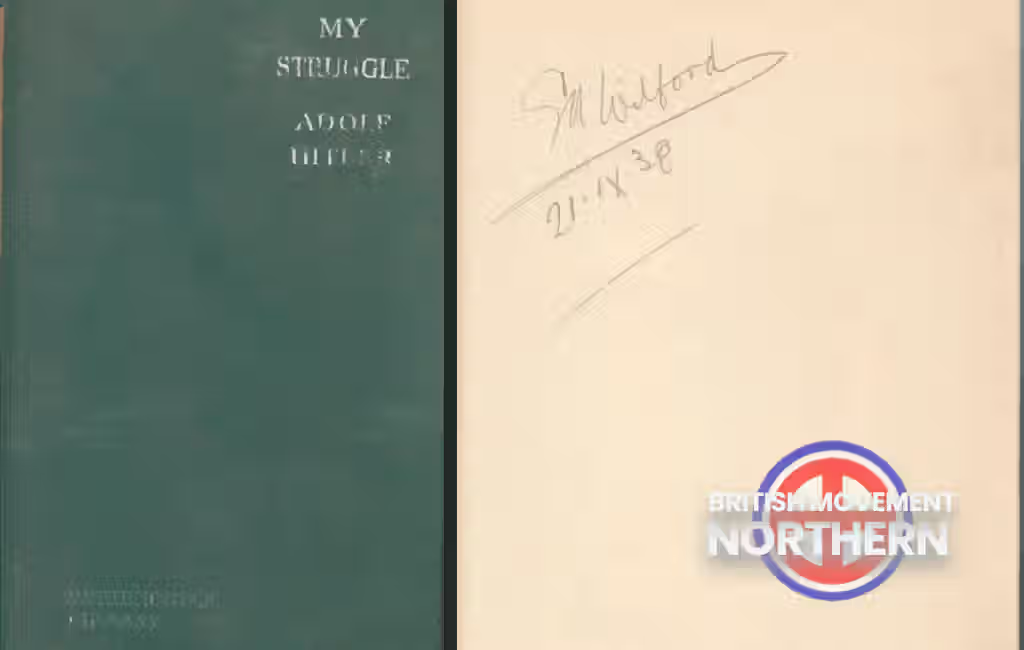
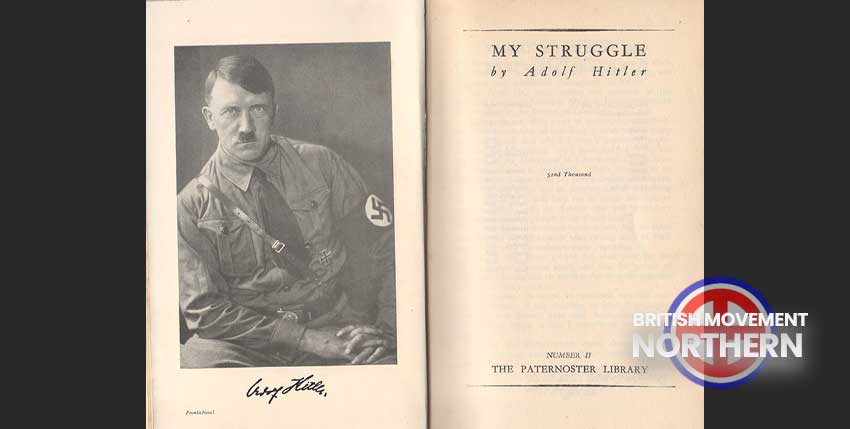
An English language edition of ‘Mein Kampf’ printed and published by the Paternoster Library in London. This hardback edition was published in 1938, although the Paternoster Library had been printing and publishing the English version of ‘My Struggle’ since October 1935.
A forgotten, slightly damaged hardback copy was re-discovered in a box of books, military badges and other collectable items originally purchased from one of the dealers at the Northern Arms Fairs, the Giant Leeds arms, medals and militaria fair at Pudsey in February 2012. It now seems like a lifetime ago.
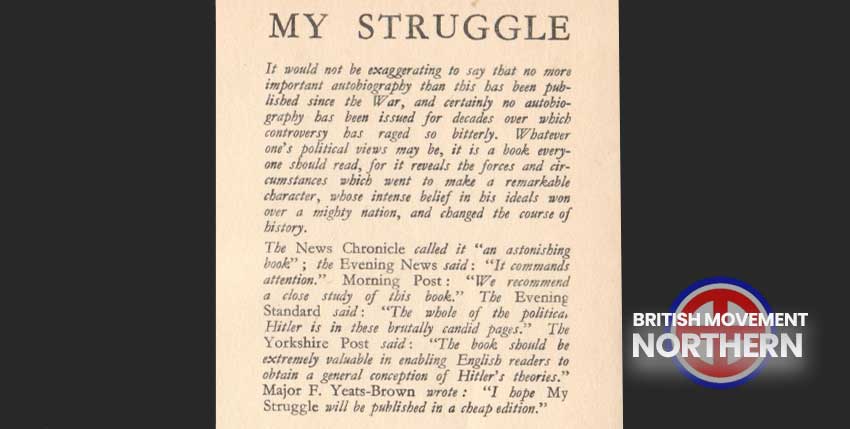
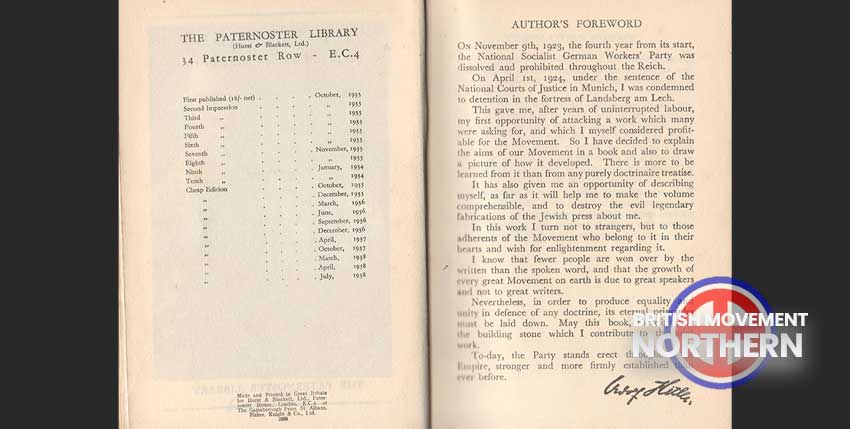
The outstanding thing about this edition of “My Struggle” (Mein Kampf) is the sheer number of reprints carried out over the three year period from 1935 to 1938, which suggests that English language versions of the book were very much in demand.
Obviously, during this period there were a number of pro-Nationalist Socialist and Fascist organisations operating in Britain, principally Sir Oswald Mosley’s British Union of Fascists and National Socialists, to give the organisation its full title, and Arnold Leese’s Imperial Fascist League. There were a number of other smaller organisations and societies which would have been pro-NS, but does that alone explain the scale of demand for this book?
Of course, in the modern era, there are plenty of nay-sayers, heavily influenced by the political Left, who would seek to decry the scale of English readership for “My Struggle”. In a direct reference to the Paternoster Library, the heavily left-wing influenced view of Wikipedia makes this analysis;
“After being sold in the 1920s to Hutchinson, Hurst & Blackett continued to publish popular fiction (historically its strength), in addition to biographies of celebrities, royalty, and historical figures and war-related titles. By and large, the imprint’s post-1920s authors and titles were not of the highest quality, instead serving, more or less, as a lower-end publishing imprint of Hutchinson.”
Hutchinson used its Hurst and Blackett imprint to publish, in 1933, a shortened translation of Hitler’s Mein Kampf called My Struggle (added to the Paternoster Library in 1936). The full translation as Mein Kampf, was published by Hurst & Blackett in 1939. The Hurst & Blackett imprint has been used for reprints and what seem to be new titles through the 1980s. In 1989, Hutchinson itself was absorbed into Random House. However, this ‘criticism’ disregards the original translator’s preface, which forms part of the introduction to this edition of “My Struggle”.
“The Translator has endeavoured, in his abridgement of Herr Hitler’s work, to include all the sentiments and ideals of government which the Author expresses in his complete work. His passionate wish for the regeneration of his race pervades the whole of the book, and he has succeeded in inspiring the youth of Germany with his ideals.”
There is no doubt that in the decades since 1945, the politically inspired writers and journalists of the liberal and progressive Left have tried to ensure that the political writings of Adolf Hitler, and in particular “Mein Kampf” is portrayed as the ramblings of the Devil incarnate and a source of the evils of racism and white supremacy. Therefore it is clear here that the very fact that Pasternoster Library saw fit to translate and publish an English language version of “Mein Kampf” was evidence of a serious lack of judgement and an error which justifies the sale and takeover of the publishers by a more acceptable company.
However, this long-forgotten English language edition of “My Struggle” demonstrates that there was a sympathetic outlet for the book in Britain and an obvious demand for the book and its ideas. Subsequent English language versions of “Mein Kampf”, such as the Murphy translation, have circulated across the post-war years and have faced criticism for inaccuracies in some of the translation and of course editions of “Mein Kampf” published by mainstream publishers have sizeable, highly critical foreword sections which echo the establishment opinion that National Socialism and “Mein Kampf” are examples of a political ideology that should never be allowed to return.
This long-forgotten edition of “My Struggle” serves as a reminder that there is another version of history, and more importantly for modern-day British National Socialists, that we should not accept the established view of politics and remember that there once was a political movement in Britain that looked to “My Struggle” for guidance and inspiration.
There is no good reason why a modern development of National Socialism should evolve and rise like a political phoenix from the chaos and shambles of the current liberal democracy, and of course this rising force will be firmly rooted in the ideas expressed in “My Struggle”.
Credits:
All Images: British Movement.
The British Movement welcomes articles for possible inclusion on this site from members and supporters across the North of England. Please remember that we have to operate within the laws of this country; we will not include any content that is against the current laws of the United Kingdom. News reports should be topical and relevant to the regions covered by this website.