
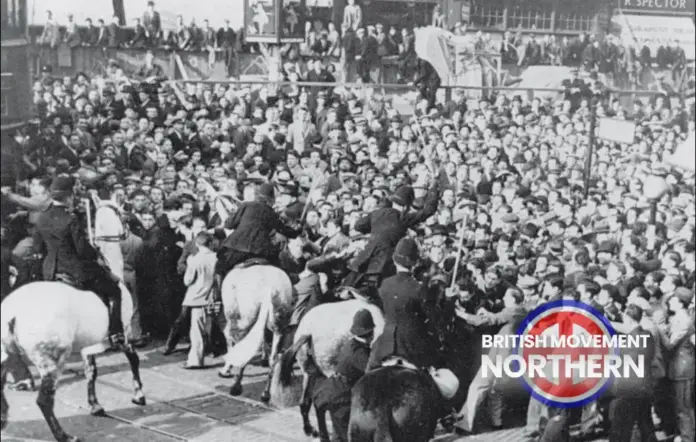
It’s ninety years since the Battle of Cable Street and the far-left make a big deal out of this day. They have built up a big myth that the East Enders of London pushed back the Blackshirts fascists, even though most of the violence was between anti-fascists and the police.
Anyway, what interests me is the British Union of Fascists members who were there on this day. I am pretty sure that a team of Blackshirts from Manchester would have travelled down to London for this big march. This thought can be applied to any town or city outside of London.
The journey time from Manchester to London in 1936 by train would have been about four hours. In those days, there were no emails or mobile phones, so all planning and meet-ups would have been arranged face to face. The Blackshirts of Mosley’s British Union of Fascists wore uniforms and therefore couldn’t hide away and spy in the same way as the anti-fascists, who could hide until they felt safe enough to attack.
A report I read said that BUF members were attacked outside a couple of Tube stations on the day. It’s important to remember that the anti-fascists were made up of communists and many Jewish immigrants, a great many of whom had come to Britain in the early 1930s after leaving Germany.
One can say that anti-fascism was largely a foreign import, unlike the BUF members, who would have been 100 percent British and whose grandparents and great-grandparents had built our cities during the Industrial Revolution.
On the day, the BUF did march away from the East End of London. I believe there were around 5,000 uniformed Blackshirts proudly marching with flags, with a drum corps leading the way. Mosley had his well-organised columns march back into the centre of London simply to help defuse the violence.
One can imagine that it must have been quite an experience to be on this march with thousands of other Blackshirts. No doubt the BUF teams from the north would have been pleased to have made the effort to travel down to London.
In the following days, when BUF members met up in their favourite pubs and told fellow members their stories, it would have been exciting news to those members and supporters who couldn’t make it. One would love to be able to go back in time and hear those stories over a beer.
No doubt these stories would have encouraged other members to save up money and travel down to London for other major events, such as the massive Earls Court anti-war rally. This is something the far-left has chosen to forget, just as they have chosen to forget the huge BUF vote in East London for Mosley in the 1937 London County Council election.
15,278 Londoners voted for the BUF, with six candidates contesting three seats in the East End of London (Bethnal Green, Limehouse, and Shoreditch). They managed to secure up to 23% of the vote in Bethnal Green. So much for the BUF being pushed out of East London.
A Manchester National Socialist.
Credits:
Main Image: Public Domain.
Video: Battle of Cable Street – YouTube.
The British Movement welcomes articles for possible inclusion on this site from members and supporters across the North of England. Please remember that we have to operate within the laws of this country; we will not include any content that is against the current laws of the United Kingdom. News reports should be topical and relevant to the regions covered by this website.