


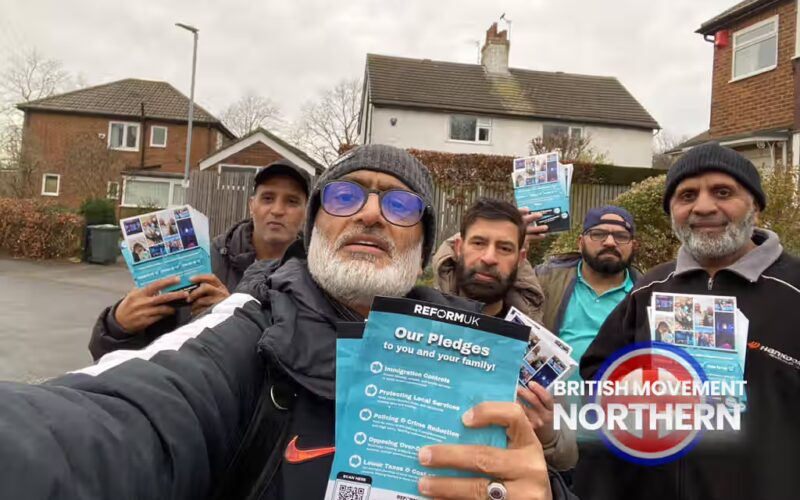
Over the weekend, a Reform UK election leaflet arrived in my letterbox. Short on policies and ideas, the most striking thing about it was its garish colouring and amateurish design. But it set me thinking.
In modern Britain – and across the entire White world – words like Nazi, Fascist, and far-right have been stripped of any serious meaning. They are no longer analytical tools; they are cudgels. They exist to intimidate, to smear, and to frighten the public into compliance. The moment anyone questions mass immigration, challenges enforced multiculturalism, or appeals to national identity, the same hysterical labels are rolled out on cue. Accuracy is irrelevant. The objective is moral panic.
Reform UK has become the latest target of this ritualised abuse, not because it represents fascism, but because it threatens power. The party, founded, owned (literally!) and tightly controlled by Nigel Farage, Richard Tice, and a small leadership clique, is on course to rupture Britain’s century-old two-party dictatorship. In under two years it has amassed a membership exceeding a quarter of a million – an astonishing figure that exposes just how brittle the political establishment has become. The reaction has been predictable: smears, exaggerations, and frantic attempts to delegitimise it.
But beneath the headlines and hype, Reform’s character is unmistakable. Rather than a clean break from the past, it has functioned largely as a refuge for the political walking wounded of the Conservative Party. Its ranks are increasingly padded with familiar names – failed ministers, disgraced MPs, and ideological chameleons seeking relevance after years of incompetence.
Danny Kruger, author of David Cameron’s saccharine “hug a hoodie” nonsense. Baghdad-born Nadhim Zahawi, sacked as Tory chairman after his tax scandal. Nadine Dorries, a mouthpiece for the Johnson era. Robert Jenrick, implicated in the secret £850 million Afghan relocation scheme. Andrew Rosindell, another career Conservative cut from the same exhausted cloth.
These are the type of people who have helped destroy Britain. They will not fix it. Reform will not fix it.
This is why the charge that Reform UK is merely “Conservatives 2.0” refuses to go away. Strip away the branding and the bombast, and what remains is a party still trapped within the narrow limits of acceptable establishment politics. The fantasy that it can be quietly infiltrated and transformed by committed nationalists is just that – a fantasy. Reform is not a revolutionary force; it is a pressure valve, designed to absorb dissent and redirect it into safe, manageable channels.
That said, the party’s rapid expansion has drawn in thousands of politically homeless supporters – people who feel betrayed, ignored, and lied to for decades. These individuals are searching for answers about identity, belonging, and the long-term future of the country they live in. Many are open to arguments that go far beyond the sterile, risk-averse nationalism on offer from Farage’s leadership. This tension – between controlled populism at the top and ideological restlessness below – is Reform UK’s defining contradiction, and it will not remain unresolved forever.


Credits:
Main Image: Reform Party Leeds North East on Facebook.
Middle Image: Reform Party Leeds North East on FB.
Lower Image: FB and British Movement.
The British Movement welcomes articles for possible inclusion on this site from members and supporters across the North of England. Please remember that we have to operate within the laws of this country; we will not include any content that is against the current laws of the United Kingdom. News reports should be topical and relevant to the regions covered by this website.