
The Financial Times printed a detailed report on how the battle against cocaine is being lost. The lengthy article started in Ireland, with officers watching satellite imagery to try and pinpoint small boats being used by drug traffickers.
The writers of the report interviewed officials who told them that the Irish coastal defences are too weak to stop most of the drugs being smuggled across the sea and hitting the streets. The Irish simply don’t have enough active navy ships to catch anywhere near enough bad guys to dent the supply.
This part of the report prompted me to wonder: if Ireland can’t stop the flow of cocaine, etc., then how can Greece, Italy or even Spain? Each of these nations has had massive floods of illegal immigrants. Their police and border guards have been overwhelmed by sheer numbers. These situations must make it easier for drug smugglers.
The report goes on to interview people at the EU drug agency’s office in Brussels. Information comes out that the European market was worth £11.6bn in 2021, and today it is about £15bn. The drug has penetrated all layers of society and the smugglers are getting more sophisticated. The example given is that smugglers mix cocaine powder with other materials such as food, plastics, textiles and cardboard to disguise it for transporting. In 2023, a record 118 tonnes was seized in ports such as Antwerp and Rotterdam.
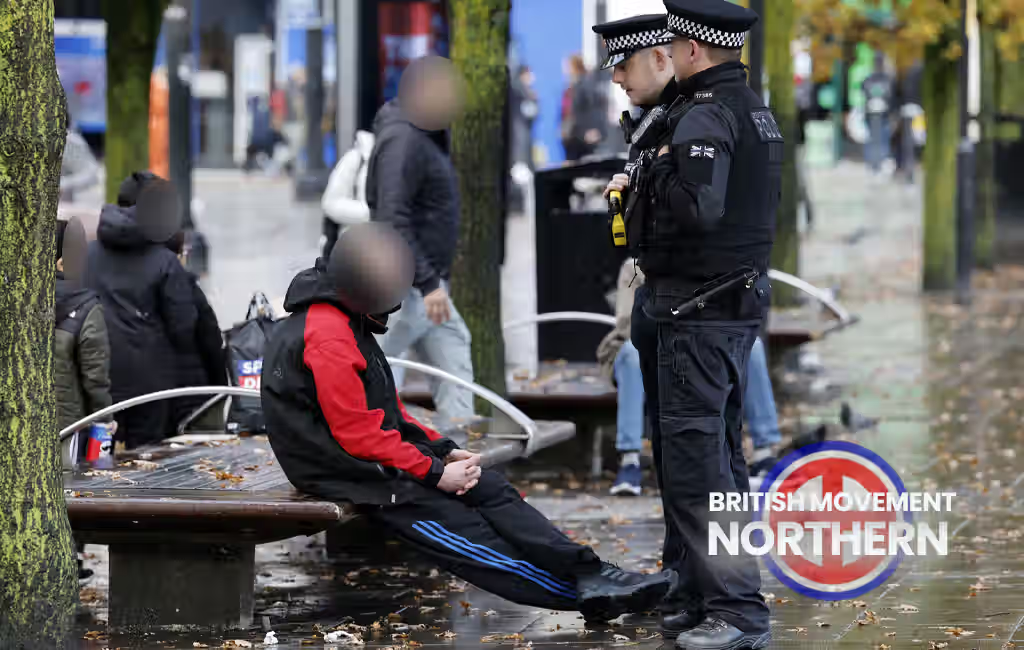
Well, I think to myself, that means this amount was probably aimed at the UK market, right? So this brings us to Britain’s streets. I am a British Movement activist based in Manchester, and I can remember during the late ’80s that open drug dealing was done on the streets of Manchester’s Moss Side. Today, it’s being done right in the city centre.
Piccadilly Gardens, which is becoming known nationwide as a hotspot for drugs, crime and antisocial behaviour, started its life during the Industrial Revolution. The area was once very grand; all the buildings that surround the then flower-bedded gardens were covered with a white stone, the kind that can be seen in London’s Bond Street and so on. At least half of those buildings are still standing. Piccadilly Gardens was once a showpiece of Manchester.
During the last two months, I have occasionally observed the Gardens when passing by after work, and this is what I have observed.
Late in the evening, there are always 30-plus youths in groups ranging from five to ten. Sometimes, the numbers hanging around can hit a good 40. It’s plain to see the police can’t, or don’t wish to, stop the low-level drug dealing that is going on. Almost all the youths are from overseas. When walking past, I notice that some of them look like asylum seekers from nearby hotels.
These groups of men basically “run the Gardens”. A few of the men cover their faces, and any intimidating behaviour towards people by these young men will largely go ignored by the police.
I have come to realise that the police will respond to requests from security guards working in outlets surrounding the Gardens: McDonald’s, Tesco, Burger King, etc. I have noticed that even Greggs and the Blank Street Coffee Café have their own security guards. My loose guess is that there are around 15 to 20 security guards at any one time working at the above outlets.
In addition to these, there are always security men in a grey uniform who manage safety on public transport. They tend to be in teams of four at Piccadilly bus station, and I have seen up to seven in close proximity to each other. These guards operate within guidelines of addressing crimes on public buses only!
This means the drug dealers don’t come under pressure from security staff based around the Gardens. So the public feel safer, and a criminal or criminals are dealt with in isolation at a store or on public transport.
My guess is this is how the authorities deliberately police the area, with the aim of keeping good race relations their main priority. The police use a team to respond to crimes of theft and aggression from ‘customers’ at the stores, and in this way the police do not have to “push” the immigrant gangs in the Gardens to react.
In today’s world of social media, a large gathering can quickly be assembled, especially if there are cries of racism. One can imagine seeing on TV police officers facing off with angry immigrant youths. We would have a public relations disaster for this “multiracial city”.
So, the situation says, buy your cocaine at Manchester Piccadilly Gardens, especially when it gets dark. Be a little discreet, and there will be no problems with the police.
So, from what I have seen with my own eyes and learnt from the FT’s report, it is plain and simple that the authorities have no intention of smashing the drug gangs importing cocaine or the gangs selling the stuff on “their” streets.
I have put up a few of the BM stickers, with the slogan, Britain Needs National Socialism. How true is this!
A Manchester National Socialist.
Video: Very Big Trouble In Piccadilly Gardens, Manchester
YouTube Auditor Charles Veitch documents escalating chaos and public safety concerns in Manchester’s Piccadilly Gardens.
Credits:
Main Image: Greater Manchester Police.
Video: Charlie Veitch YouTube.
The British Movement welcomes articles for possible inclusion on this site from members and supporters across the North of England. Please remember that we have to operate within the laws of this country; we will not include any content that is against the current laws of the United Kingdom. News reports should be topical and relevant to the regions covered by this website.