



In this article the focus is on a historic landmark, not a town or village, but one with a forgotten significance for Northern England. It is also potentially further evidence of the gradual eradication of traditional Britain in favour of a more ‘diverse’ reflection of ‘progressive’ heritage and culture.
Castle Hill is a prominent local landmark with many centuries of significance for the town and the surrounding villages. Most prominent is the nearby village of Almondbury, which was once more important than the later town of Huddersfield (previously known as Odersfeldt).
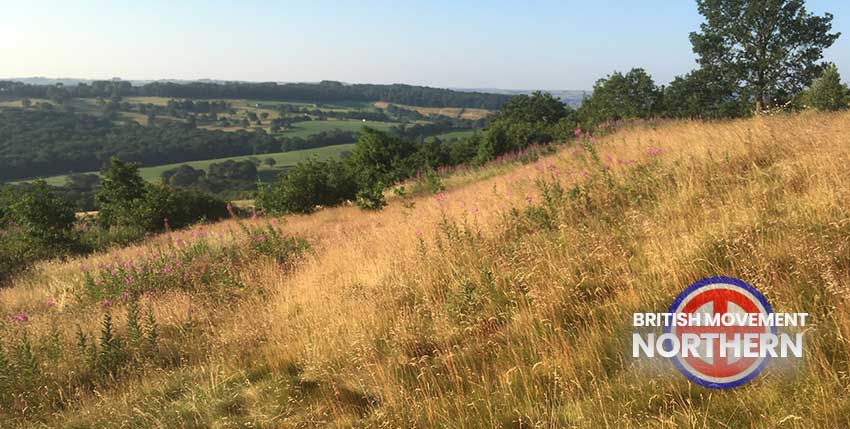
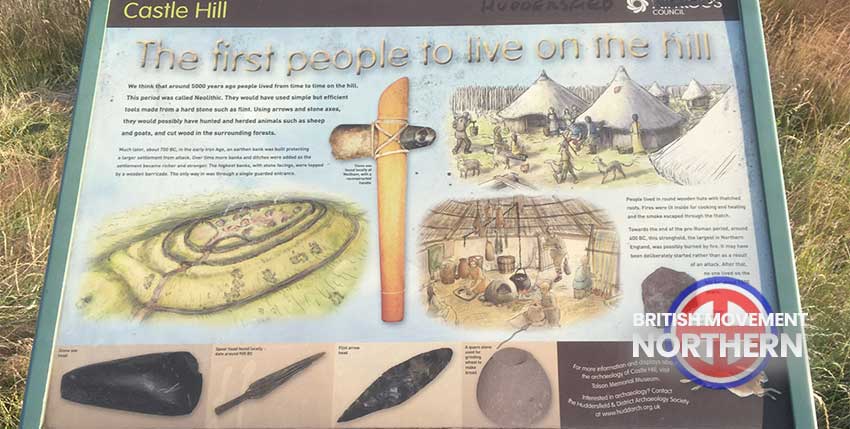
A brief history of Castle Hill is offered by a local historical publication: “The first people to visit Castle Hill were probably hunters and gatherers of the Mesolithic age, camping amongst the forests which at that time covered the land. In the Neolithic and Bronze Age, there appears to have been widespread travel or trade along the river valleys connecting the Yorkshire Wolds, the Peak District and the Mersey and Ribble estuaries. This is shown by various characteristic types of stone and bronze tools in a place far from their points of origin.
“The hillfort was constructed in the early Iron Age, around 555 BC taking up the whole hilltop. Modifications were made around 43 AD to improve the defences, probably in response to the threat from the Roman invaders.”
The likely Iron Age occupiers of the hill fort were from the Celtic Brigantes tribe, and there are some old accounts of the history of the district which suggest that prior to the arrival of the Roman invaders the site was an occasional site for the courts of the Brigantes tribal kings and queens, including the famous Queen Cartimandua. However some historians dispute this; “By the early 50s AD, they (Brigantes) were being ruled by Queen Cartimandua. She lost her control of the tribe in AD 69, following an uprising led by her ex-husband Venutius. The Romans put down the rebellion and then went on to conquer the rest of northern Britain.
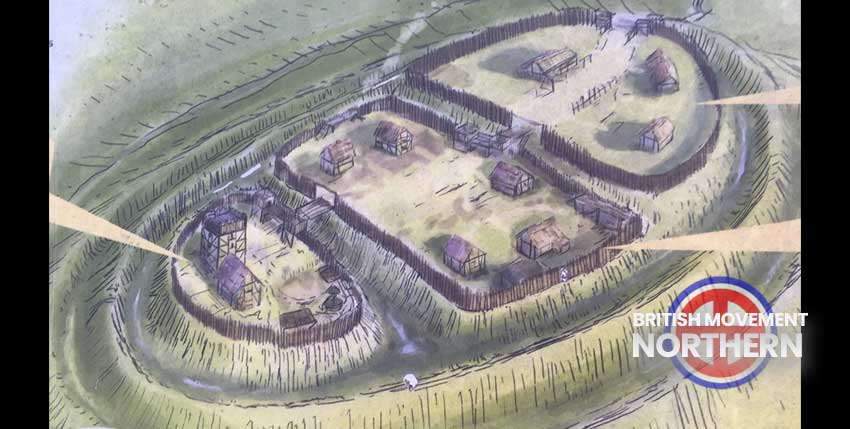
“Around 431 BC, the abandoned fort was destroyed by an unexpected fire. Note that this was centuries before the Roman conquest of Britain. Because there appeared to be no reason for a fire to start on an uninhabited site, local folklore spun the tale that a dragon resided within the hill. The excavations concluded that the rotten timber that had been used in the core of the rampart had created so much methane it combusted.
“In the post-Roman and Anglo-Saxon period it seems that there was little use of the hill fort… it does seem likely that the hill retained a sinister reputation among the English, who called it Wormeclyff. The word ‘clyff’ (cliff) was once used for any steep bank, and the word ‘worm’ in old English meant a serpent-like, fearful creature that haunted old ruins or guarded lost treasure.” Certainly the local legend of a “worm” or fire breathing dragon living on the hillside persisted for centuries.
In 2026 the hillside known as Wormcliffe is heavily covered with mature trees and bushes, a Norman era motte and bailey castle.
“The banks and ditches that remain are more likely to be the result of recutting and other alterations carried out during the Middle Ages, and modified by centuries of erosion. After the Norman Conquest of 1066, Almondbury became part of the Honour of Pontefract, which was held by the de Laci family. They established a small castle on the hill. It is mentioned in a charter of King Stephen to Henry de Laci of about 1142 to 1154.
“It can be assumed that the castle was complete and occupied by the 1140s. In the early 14th century there was an attempt to found a settlement in the lower bailey, and possibly elsewhere on the hill. Aerial photography revealed a central roadway flanked by regularly laid-out plots. It was probably abandoned by the 1340s, although memory of it may have lingered, since the map of Almondbury drawn up in 1634 marks the hill as the site of a town.
“After the end of the Middle Ages, Castle Hill remained uninhabited until the early 19th century. Its prominent position made it an ideal site for a warning beacon, as part of a network of such beacons on other prominent hills all over the country, spreading out in lines from the coast.”
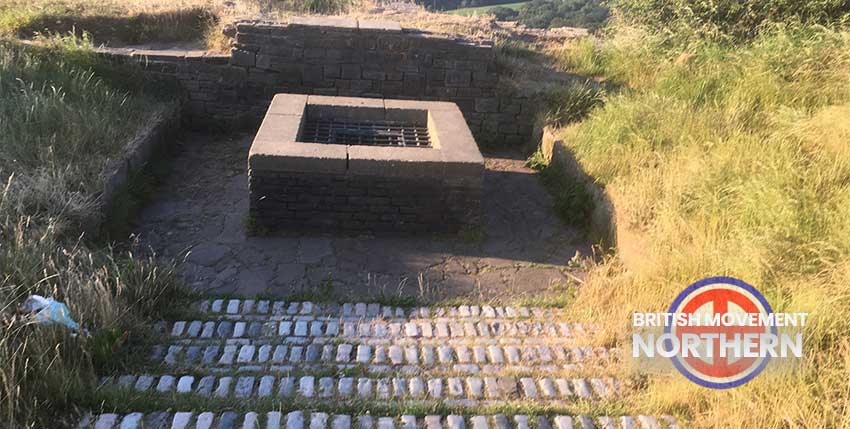
The only remnant of the Norman castle today is the stone enclosure of the castle well, deeply dug down into the hill, it was the only water source available to the Norman garrison.
The 19th Century history of Castle Hill.
“Castle Hill’s flat top was a venue for large political, religious, and other meetings. Chartist rallies were held at least four times, in 1843 and 1848. During the great weavers’ strike of 1883 a rally of between two and three thousand people braved bitter weather to listen to speeches by union leaders. A tavern to cater for pleasure-seekers was built on the hill in about 1810–11. A bowling green was formerly situated to the south of it. Other pursuits recorded there included bareknuckle prize fights, dogfights and cockfights.”
The Victoria Tower.
Unfortunately many ill-informed people think that the name Castle Hill is a reference to the prominent Victorian monument. The present tower was built to commemorate Queen Victoria’s Diamond Jubilee of 1897.
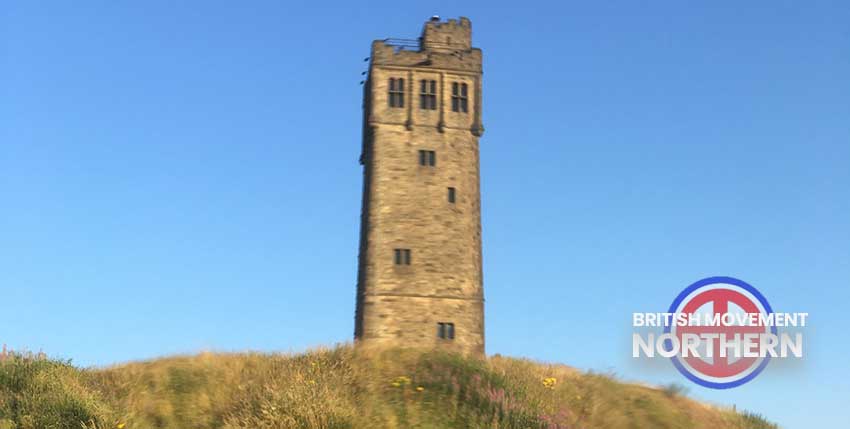
“Perched on Castle Hill, Victoria Tower was completed in 1899 to celebrate the 60th anniversary of Queen Victoria’s reign. The corner-stone of the tower was laid on 25 June 1898 by Mr John Frechville Ramsden and was officially opened by the Earl of Scarborough on 24 June 1899. The walls of the tower are four feet thick at the bottom, tapering to two feet at the top. The tower was renovated in 1960 when the top seven feet were removed. It reaches the height of almost 997 feet above sea level. In November 2012 the lantern light on top of Victoria Tower was replaced due to the original light that had failed. The red LED light on the top of the building meets aviation regulations and uses the same energy as a 35W bulb.”
The 20th Century and the recent history of Castle Hill.
“Remains of a Second World War Anti-Aircraft battery at Castle Hill.
“An anti-aircraft battery was built near the south-east end of the hill and a range finder is located at the north side of the outer bailey, the remains of which may be seen, and pieces of high-explosive shell casings are occasionally picked up in the adjacent fields.”
Another relic of the Second World War in the vicinity of Castle Hill was a prisoner of war camp set down in the fields adjacent to the hill, which held Italian POW’s. The foundation outlines of the camp huts were still visible in the 1970’s.
“It is thought the old pub was demolished in the late 1940s or early 1950s, leaving just the hotel next to the tower.” But for most of the pre-21st Century residents of Huddersfield it was the hotel on Castle Hill that was significant as a good place for a drink and also a place with function rooms for wedding receptions and large family events or even a fund-raising ‘disco’.
“The hotel was acquired by developers the Thandi brothers in the 1990s with plans to re-furbish the hotel and remove later additions which disfigured the building. Planning approval was given in 2002 but during the course of demolition works the tower became unstable. Permission was granted to replace the original building but as construction progressed it became clear that the new building was larger than that for which permission had been granted. Work on the site was stopped. Subsequently, an order was served for the demolition of the building.
“Since then, the leaseholders – Castle Hill remains part of the Ramsden Estate which was bought by Huddersfield Corporation in 1920 – have submitted several new plans.”
As some readers of the BM Northern region website will have deduced from the names of the development/property investment company Thandi Brothers Ltd, then The Thandi Partnership, the Thandi brothers are not White Europeans and despite being known by the anglicised names of Mick Thandi and Barry Thandi, are of ‘South Asian heritage’. It has been argued by many objectors that the Thandi brothers have no ancestral connections to Castle Hill and its history and therefore just regard the site as being another parcel of land for development.
These were all rejected until the present application for a restaurant and bar with six bedrooms and a visitors’ centre with toilets was approved on October 28, 2020. The low-lying building – variously described as a much-needed facility, a monstrosity or as looking like a branch of McDonald’s – is at the centre of an ongoing debate.
“The plan will go ahead unless English Heritage refuses to give Scheduled Monument Consent for it after the Government refused to become involved in the decision-making.”
It is the proposed ‘visitors’ centre’ that has provoked much local anger, particularly as it is being presented as a ‘diverse or multicultural’ facility, set on such an important historic site.
“A company, owned by two brothers – Mick and Barry Thandi – known as the Thandi Partnership bought the Pub adjacent to the Victoria Tower, which was a Free house, on land leased from Kirklees Borough Council, and applied for planning permission to renovate it. The planning approval required some of the original walls to be retained, the original dimensions to be kept and the cellars to be kept with no increase in the overall size of the building. Local stone was also required to be used in keeping with the farm buildings and housing in the area.”
“During the rebuilding the brothers totally demolished the pub, dug out and increased the size of the cellars, the height of the roofline and the plan dimensions of the original building. These were noted in Huddersfield Civic Society Newsletter 2004. Concerned local residents objected and after several ignored warnings, by the building inspectors, the local council halted the building work.
“Eventually, after 3 years and a lengthy court battle, the pub was fully demolished, the cellars were filled in with the building rubble and the area covered. The steel girders used in the construction were cleared from the site by an outside contractor. Subsequent plans submitted by the brothers to rebuild the pub have been rejected by the council as they did not comply with the requirements previously specified to them. The matter remains unresolved.”
Even Wikipedia carries a reference to Castle Hill.
“Castle Hill is a scheduled ancient monument in Almondbury overlooking Huddersfield in the Metropolitan Borough of Kirklees, West Yorkshire, England. The hilltop has been settled for at least 4,000 years. The scheduled monument comprises the remains of a late-Bronze Age or early Iron Age univallate hillfort with a single raised bank, a later Iron Age multivallate hillfort, a 12th-century motte-and-bailey castle, and the site of a deserted medieval village. The grade II listed Victoria Tower on the summit of Castle Hill is by far the most conspicuous landmark in Huddersfield.”
Given the official status of Castle Hill as a scheduled monument with the additional Grade II listed status of the Victoria Tower and all the local history of the hill, including the legend of the dragon on the hillside of Wormcliff, it is a bizarre suggestion that the hill should have a multicultural visitor centre.
Not surprisingly the local council, the Labour Party dominated Kirklees Council, offers a bureaucratic response to the objections. “Plans for a £3.75 million visitor centre with bedrooms on Castle Hill have been approved again by Kirklees Council – on the casting vote of the planning committee chairman. Hundreds of people had objected to development on the Scheduled Ancient Monument which dates back over 4,000 years.”
The six councillors on the Strategic Planning Committee were split and the vote was tied at 3-3 but approval went through on the casting vote of Labour councillor and committee chairman Cllr James Homewood. Former council leader Cllr Cathy Scott (Community Alliance) proposed approval, seconded by Labour’s Mohan Sokhal. Cllr Andrew Pinnock (Lib Dem), Cllr Susan Lee-Richards (Green) and Cllr Bill Armer (Conservative) all voted against.
The report recommends that councillors agree to delegate approval of the application and the issuing of the decision notice to the Head of Planning and Development who needs to ensure the conditions are clearly laid out and that The Thandi Partnership provide a management plan for the exhibition/interpretation room and that access to the toilets must be free of charge. This most recent application has drawn more than 120 responses with some in favour of the plan and many against it.
The plan is supported by Historic England which states: “Historic England continues to believe that this important and sensitive site could accommodate a well-designed building that delivers real public value provided that such benefits are tangible, clearly defined and sustainable.”
Its only reservations were about the viability of The Thandi Partnership’s business plan “to ensure that the proposed benefits set out can be realised.”
“Under the new plan The Thandi Partnership says the Castle Hill CIC will run as a community interest company and include representatives from local community groups, heritage professionals and ‘council stakeholders’ so all decisions and operations serve the wider public interest.”
It is a sad reflection on life in modern Britain that such a historic site is viewed by non-white, capitalist businessmen as a development opportunity, and by left-wing politicians as an opportunity to ‘celebrate’ diversity and to use the ‘heritage visitor centre’ to include the customs and beliefs of those immigrant communities who only began to arrive in Huddersfield from 1950 onwards.
Diversity is not part of Castle Hill’s story.
Resources
All Images: Public Domain/BM Northern
The British Movement welcomes articles for possible inclusion on this site from members and supporters across the North of England. Please remember that we have to operate within the laws of this country; we will not include any content that is against the current laws of the United Kingdom. News reports should be topical and be relevant to the regions covered by this website.