
Our politicians knelt en mass to show their outrage at the killing of George Floyd, a black American career criminal and drug addict. One now infamous image is of Keir Starmer and his deputy, the odious Angela Rayner, taking the knee in his memory. The police, in an act of subservience and cowardice, knelt before aggressive Black Lives Matter Marxists, who in turn screamed insults and threats towards them. Multi-millionaire footballers also took the knee before matches, much to the disgust of the fans who had paid their hard-earned money to watch them.
And it changed the way the police viewed crimes involving ethnic minorities. No longer was everyone equal before the law. The police Race Action Plan made sure of that. Forces became proactively ‘anti-racist’. It was this anti-racism policy that led to the harrowing treatment of Henry Nowak at the hands of four Hampshire police officers who were ‘just obeying orders’. These officers, along with their cultural Marxist-inspired superiors, must be prosecuted over their behaviour, sacked and lose their police pensions.
The following text is taken from the Sentencing Remarks of Judge William Mousley K.C. on 1/6/2026
Stand up, please. Henry Nowak, aged 18, died on 3/12/2025. He was a much-loved, kind, hard-working and ambitious young man, devoted to his family and with a bright future. He was a first-year student at Southampton University, the first in his family to go to university. He was careful and principled, full of humour, warmth and promise. 2. You, Vickrum Digwa, murdered him. By doing so, you robbed him of all those he loved, all the things he cared about and liked to do. He would have been expected to live a long, hopefully, happy and fulfilling life. You have brought misery and a lifetime of loss upon his family and great sadness to everyone who knew him.
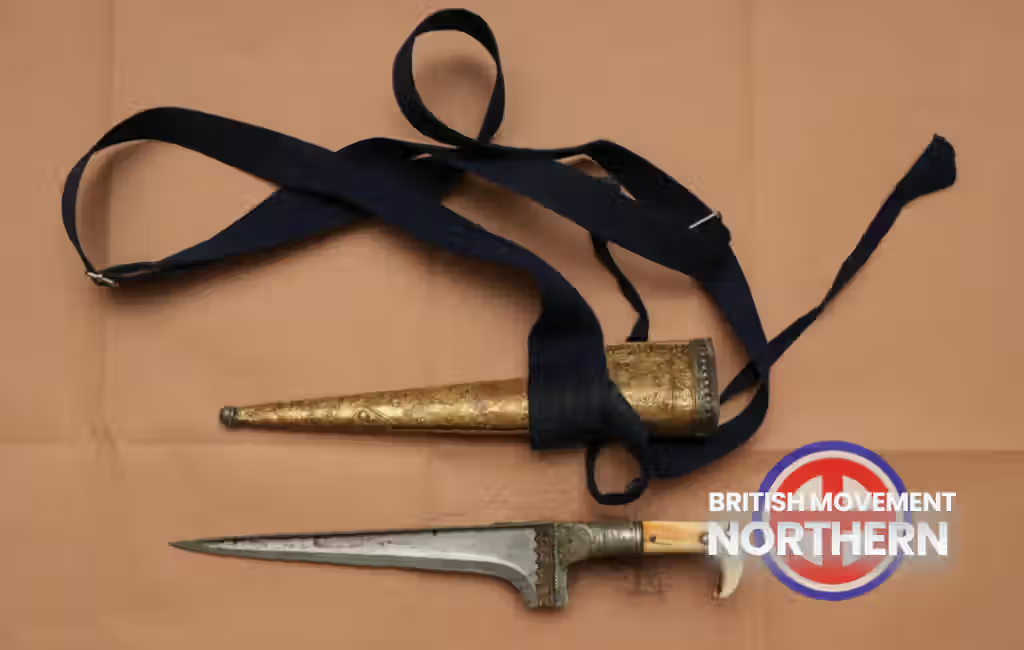
You drew the dagger from its sheath and, as the jury was sure, you deliberately stabbed Henry in the chest with it. The knife passed through several layers of clothing, as demonstrated by the multiple slits in his dark top where the material had been overlaid on itself in the struggle and the single slit in his shirt. It passed upwards through soft tissue, between the two uppermost ribs, catching a lung and cutting an important vein, behind the collar bone. This was to a depth of 8cm from the skin surface. The consequent bleeding flowed into his chest cavity. The pathologist, Amanda Jeffrey, found 1200 ml, or over 2 pints, of blood there.
You also stabbed him twice to the upper leg at some point and once again to the lower abdomen/groin area at the front. The latter only resulted in a knife tip injury; the former were both to a substantial depth, although not as deep as the chest wound. Henry’s face was also slashed with the blade of the dagger but I cannot be sure that was aimed or intended. However, one or more of the four stabs must have had an immediate effect as Henry was never able to put up his hands to defend himself from further serious injury. He was defenceless.
You, by contrast, had little, if any, injury. You told the attending police that you had a small bruise and swelling to your eye from a punch but it is not obvious on body-worn footage taken then and there has been no independent evidence given in the trial of any injury at all to you.
Your brother, Gurpreet, arrived on the scene very shortly after your attack had finished. You then filmed Henry desperately trying to get away from you, somehow scaling a fence, onto a communal bin, before landing on a car in front of the property next door. Bloodstains show that he had got one, more or all his injuries before then.
You then showed a callous disregard for his wellbeing, knowing you had stabbed him to the chest. You continued to make films of Henry suffering, ignoring much of his desperation at having been stabbed. You told him that had not happened, no doubt to convince others who were nearby. Your attitude did not change even though Henry was clearly going downhill very fast. Your brother did much the same, although he may just have been accepting that which you had told him, rather than lying himself. You lied to him that you had been attacked, picking up on his question about whether it had been accompanied by racism by falsely claiming that Henry had called you a “Paki.” I am sure that Henry had said nothing racist. You are the only person to make that claim and it is completely at odds with his previous character.
You joined your brother in relating these lies to the police. By then your mother and father were at the scene. Gurpreet explained that no weapons had been involved or were present. In fact, whilst he was talking to the call operator, you told your mother to take the murder weapon, sheath and belt away which she did. You did not tell your father what had really happened. Much of the time you just stood by as he, at least, tried to do something to help Henry.
You carried on telling these wicked lies when police attended on the scene, hampering them in doing their job and, effectively, obstructing the course of justice. You kept Henry’s phone with the incriminating recording of you on it. You had no intention of handing it over. It was found on you after you had been arrested and taken into police custody.
Thereafter, the time came when the police needed permission from a court to extend the time for you to be questioned in custody and arranged for you and Gurpreet to be taken there for that purpose. They took the opportunity to record secretly any conversation between the two of you on the journey. Speaking in Punjabi, you agreed to pretend you had acted in self-defence even though you confessed to stabbing Henry three times, including once to the chest with the dagger. You knew you were guilty, demonstrated by your saying to Gurpreet that if there were any cameras in that part of Belmont Road, you would be unable to put forward self-defence. You decided, much as you had at the scene, to try to cover it up. In all your police interviews, you decided not to answer questions about the incident. Instead, you made a written statement, on 7/12/2025, which told more lies. Once the criminal proceedings were underway, you made another statement, developing and modifying those lies. It was only when you gave evidence in court, that you put forward your full defence. The jury entirely rejected that defence and I do too.
You bear some responsibility for the offence committed by your mother when you asked her to take the murder weapon away from you after she arrived on the scene. Your lies to the police about what had happened led, in part, to the arrests of your father, brother and mother for murder and their being taken into police custody. Your mother has remained in custody for the past seven months.
You were still present at the scene when Henry was saying he was dying and still you did not tell the truth about how seriously you knew you had hurt him and the need for urgency. Instead, you said he had not been stabbed and that he was exaggerating.
There are a number of aggravating factors to increase the starting point. In no particular order, they are as follows, Firstly, you stabbed Henry three other times than when inflicting the fatal wound, all with a highly dangerous weapon. Secondly, mental suffering was inflicted on Henry once he lay dying from his injuries, by your attitude towards him of which he would have been aware and, separately, by your lies which had resulted in a young adult of good character being arrested and handcuffed. Thirdly, there was additional degradation by filming his suffering. Fourth, your repeated and concerted actions after the event included attempts to cover up and to conceal evidence had a tendency to pervert the course of justice. Fifth, you wrongly placed blame on Henry and your lies also led to unnecessary arrests for members of your family which would not have happened if you had told the truth. Sixth, you prevailed upon your mother to assist your attempts to pervert the course of justice. Seventh, Henry was only 18, unarmed and alone which made him additionally vulnerable. Eighth, the offence has had a significant community impact upon others as described and evidenced in press reporting and social media reaction.
Stand up, Vickrum Digwa. The sentence on Count 1 is Life Imprisonment with a minimum term of 20 years and 190 days before there can be any consideration given to whether you can be safely released before the end of your life. On Count 2 the sentence is 2 years imprisonment concurrent to Count 1.
Credits:
Main Image: The murder weapon used by Digwa. Photograph: Crown Prosecution Service.
The British Movement welcomes articles for possible inclusion on this site from members and supporters across the North of England. Please remember that we have to operate within the laws of this country; we will not include any content that is against the current laws of the United Kingdom. News reports should be topical and relevant to the regions covered by this website.